

All news
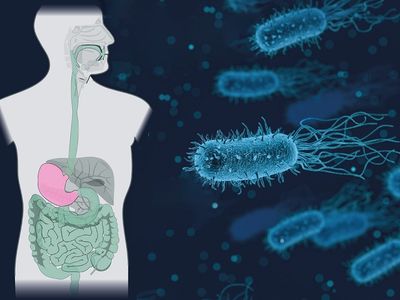
Human pathogens prevent "misfiring" of their type III secretion system by sensing pH
Under the lead of the Diepold group, we found a new mechanism on how human pathogenic bacteria prevent "misfiring" of their type III secretion system in the wrong environment and remain "silent" invaders until reaching the human intestines. One protein, anchored in the membrane, becomes more motile at low pH (e.g. in the human gut) which inactivates the secretion system. Our work is now published in Nature Communications.
Read more … Human pathogens prevent "misfiring" of their type III secretion system by sensing pH
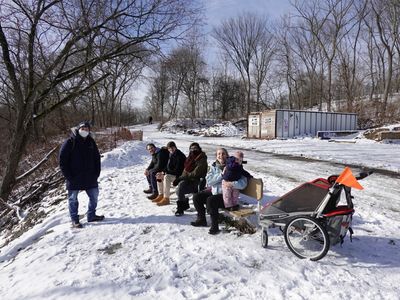
Winter hike at Frick Park
Snow just after Christmas! Since we were all (yes, the whole group!) staying in Pittsburgh over Christmas break (all of our families are on the other side of the Atlantic - but Covid 19 travel restrictions kept us here), we explored snowy Pittsburgh - equipped with hot tea, lots of cookies, and warm cloths.
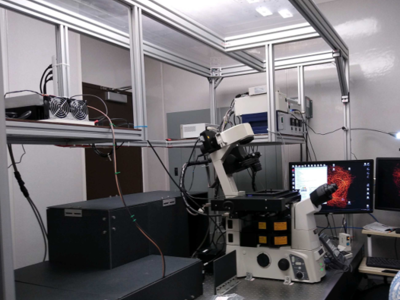
Our microscope is up and running again!
Our last "imported" team member is finally back on track: welcome back "Blinky"! Our customized microscope - which we brought with us all the way from Germany - is now single-molecule sharp again & ready for new adventures!
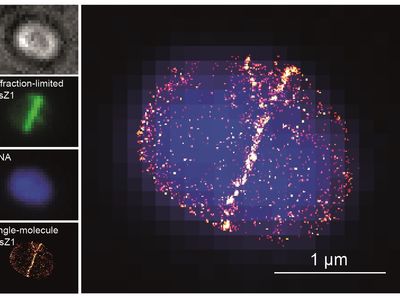
Single-Molecule Localization Microscopy to study Archaea
In our new study, we, together with the Marchfelder group in Ulm, laid the groundwork for expanding the use of single-molecule localization microscopy (SMLM) to archaea. The research is now published in Frontiers of Microbiology.
Read more … Single-Molecule Localization Microscopy to study Archaea

Ulrike receives Cooper-Siegel career development chair
Ulrike has received the Cooper-Siegel Career Development Professorship. This professorship, which alternates between Carnegie Mellon University's Department of Physics and School of Computer Science, supports an early career faculty member.
Read more … Ulrike receives Cooper-Siegel career development chair
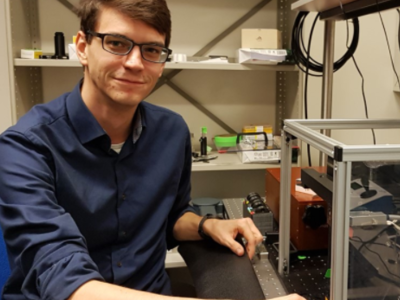
A big welcome to Koen!
Our second new member joined us at CMU! Koen Martens just defended his PhD with Johannes Hohlbein in Wageningen, and now joins our new adventures here in Pittsburgh! The warmest welcome to you and your familiy, Koen!

AI-driven discovery in biophysics
Register for our virtual conference: AI-Driven Discovery in Biophysics, a CMU/Pitt conference organized by CMU biophysicists Ulrike Endesfelder and Shila Banerjee and CMU computational biologist Russell Schwartz, will be held Wednesday, November 11 from 9 a.m. - 2 p.m.

A big welcome to Patrick!
Our first new member joined us here at CMU! Patrick Keyser will help us as our new research assistant with a smoothly running biolab! The warmest welcome to you, Patrick!
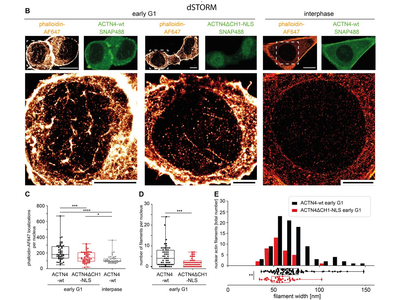
Divide and Enlarge - A new mechanism by which cell nuclei grow
One of the most important processes in cell development is cell division. In a joint project with the Grosse lab in Freiburg, Germany, we now discovered that bundled fibers of actin within a cell nucleus play an important role in how cells enlarge after division.
Read more … Divide and Enlarge - A new mechanism by which cell nuclei grow
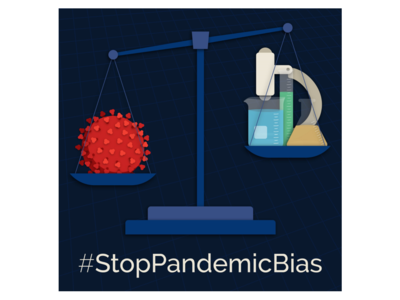
#StopPandemicBias
New correspondence to nature: “#StopPandemicBias: scientists, share your privilege“.
Our goal is to raise awareness in the multiple ways the current pandemic creates vastly different challenges for different people, and it behooves us all to combat the resulting biases and undeserved privileges.